
Easy to integrate, compliant by design: Bringing the Swiss Franc to Google Cloud Universal Ledger
Every day, countless financial transactions are interrupted by slow, expensive, and inflexible conventional payment systems. As a result, public commercial stablecoins like Tether, USDC, and PayPal USD have become increasingly popular by making it easy to move money efficiently with instant, 24/7 blockchain settlement.
Yet major regulated banks have largely kept such transactions at arm’s length; for these financial institutions, reserve-backed public stablecoins present numerous risks, including strict capital and liquidity requirements and unmanageable regulatory and operational uncertainty.
Indeed, banks don’t want to adopt existing stablecoins. Instead, they need the speed and efficiency of tokenized currency built on the trusted economic foundations they’ve nurtured over years or even decades in business. That’s why many are now turning to Google Cloud Universal Ledger (GCUL). Rather than channeling public stablecoins, GCUL provides the secure infrastructure banks need to issue and settle tokenized deposits. That brings real-time, 24/7 programmable payments into commercial bank money while satisfying regulators and without disrupting core banking operations.
For many banks, this is a compelling vision, but adopting new payment technology and integrating it with core banking systems can seem to bank CTOs like a daunting undertaking. That’s particularly true as they face mounting demands for the engineering resources that keep their businesses running while also striving to stay compliant with new regulations. But with a blockchain purpose-built for financial services like GCUL, this is anything but a herculean task.
Looking to expand its offerings for an increasingly global clientele, Switzerland’s Crypto Finance Group wanted to show it could deploy payment innovations like this in just weeks. That was its inspiration for launching a digital payments infrastructure pilot that enabled instant account-to-account transfers between customers of two Swiss banks on the GCUL network. The pilot, which was designed to operate within one of the world’s most demanding financial security frameworks, provided a blueprint for how any commercial bank can build on Google Cloud technology to fundamentally modernize its payment operations.
Pain points in today’s payments landscape
In recent years, there’s been a marked proliferation of tokenized payment methods. But stablecoins have transformed this previously niche technology, by effectively resolving some of traditional finance’s most enduring pain points, such as weekend transfer blackouts, direct transfers without correspondent banks, and fast settlement rails. Stablecoins also limit the frustrations caused by opaque cross-border transactions, where fragmented compliance checks can leave legitimate payments in extended and unexplained limbo and without a path to clear or timely resolution.
Still, commercial banks have been reluctant to offer popular reserve-backed stablecoins from permissionless blockchains to their customers despite their retail popularity. That’s because they come with numerous challenges to smooth and secure operations: an uncertain regulatory status, compliance issues around anonymous accounts, gas fees, and the scalability limitations of layer 1 blockchain technology. But perhaps banks’ biggest concerns about stablecoins is that they create a problematic economic disconnect — giving customers access to reserve-backed stablecoins reduces reserves and, as a recent McKinsey study found, banks’ ability to lend.
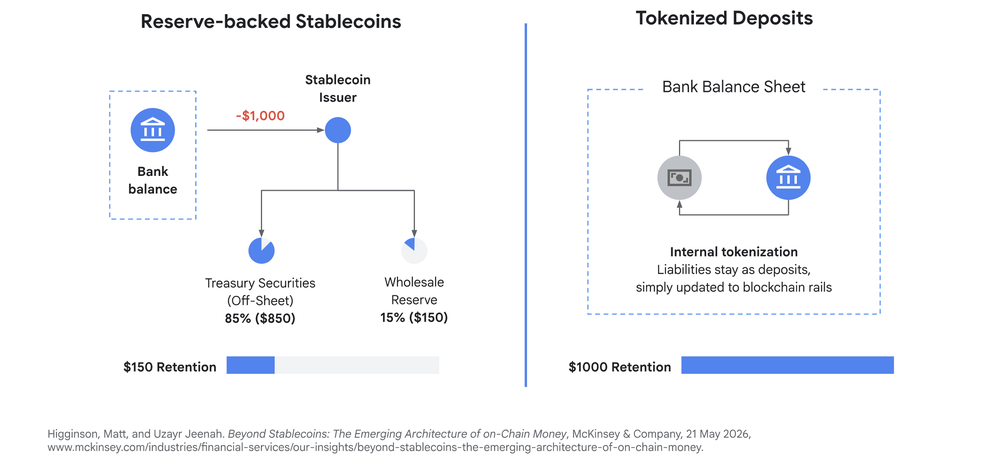
As a result, many banks are trying to figure out how to offer their customers the benefits of stablecoins — high speed, low cost, 24/7 availability, and programmability — without introducing problems often associated with existing reserve-backed stablecoins, such as regulatory issues, poor throughput performance, negative influence on bank reserves, and potentially no yield participation.
Solution proposal
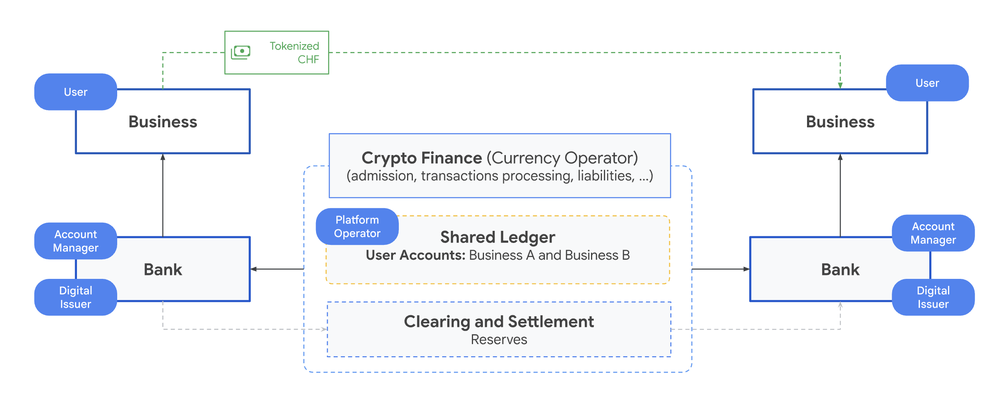
Realizing this vision means modernized payments architectures must seamlessly and instantly enable individuals and institutions to transfer bank-held assets to accounts at any target bank. Orchestrating this shared ecosystem requires central entities to establish the governing rulebook, enforce issuance limits, and manage network-wide settlement parameters. During its pilot, Crypto Finance assumed this role, which within GCUL is known as the “currency operator.”
In this position, Crypto Finance can configure the network for either instant or deferred settlement. This choice is analogous to traditional banking: instant settlement acts like real-time gross settlement, where transactions settle individually and immediately and require high liquid reserves. In contrast, deferred settlement operates like netting, where payments are accumulated and offset and only periodically settle the net difference. For the pilot, Crypto Finance chose to adopt deferred settlement, in which GCUL manifests capital efficiency. In this way, clients enjoy instant transfers while banks conserve liquidity through periodic settlement.
Concept validation
To demonstrate instant, bi-directional account-to-account transfers on GCUL, Crypto Finance orchestrated a pilot with two digital token issuers, a Swiss digital asset bank, and a Swiss B2B transaction bank. Crypto Finance established the rulebook for interactions between the participant banks, such as interbank settlement, integration with traditional SIC payment rails, and AML/compliance protocols. Although some backend steps still needed manual intervention, Crypto Finance’s pilot proved that fully automated, cross-institution integration is feasible and established a generalized architecture that can scale to virtually any asset class.
Robustness and performance
A temporary pilot is one thing; moving into live client transactions carrying legal liability brings a whole new set of operational challenges. Live payment rails are considered critical infrastructure that demands security and availability. GCUL addresses these needs through redundancy between geographically distributed nodes operating on an enterprise-grade consensus model, ensuring reliability. Deploying client workloads on Google Cloud provides that enterprise-grade foundation and allows financial institutions to pair the highly resilient GCUL network with secure-by-design infrastructure, encryption at rest and in transit, and robust access controls that satisfy many of banks’ common regulatory, privacy, and data sovereignty mandates. While some banks may consider integrating their systems with fully public and permissionless blockchains, this approach introduces severe regulatory hurdles, anonymity risks, unpredictable gas fees, and low throughput. These are all roadblocks that in the past would have significantly delayed the pilot or rendered it a non-starter.
Ease of integration
The pilot’s implementation, with systems integration completed in under three months, was compartmentalized across dedicated Google Cloud projects per participant. The currency operator, Crypto Finance, connected specialized components to a dedicated GCUL API. The first was a role admin service that controls account managers and token managers on the network. Next, it implemented a settlement registry to record when periodic off-ledger settlement between participant banks has occurred once a predefined threshold is reached. Finally, a cloud key management service (KMS) stored the currency operator keys to sign transactions.
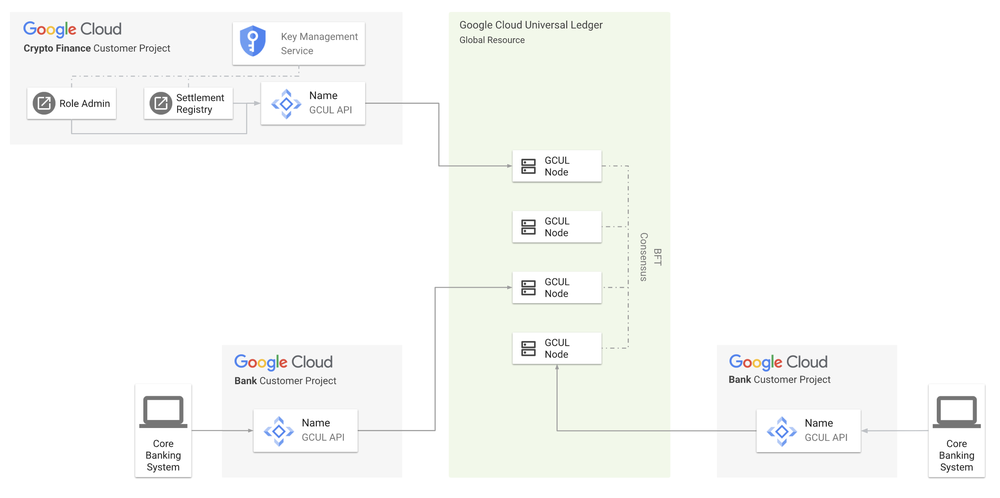
At the same time, participant banks connected their core banking systems to their own GCUL API instances. But these participant banks don’t need a large Google Cloud footprint. Instead, they can connect to GCUL nodes via Remote Procedure Call from their existing on-premise deployments and manage private key material through solutions other than KMS. Regardless of the setup, transactions are seamlessly routed to the shared global GCUL nodes.
Whether GCUL is exposed to a bank’s client or used merely as a bank backend is entirely at the integrating institution’s discretion. The banks participating in the pilot chose the latter, utilizing the ledger to upgrade their backend infrastructure. With GCUL under the hood, they improved intra-day transaction performance and provided customers with the user experience they were already accustomed to.
Regulatory compliance and governance by design
To join the Swiss Franc currency network on GCUL, participants must have regulatory licenses that let them perform third-party transfers and issue commercial bank money. Crucially, features like token and account management are not rigid network-wide limitations. Instead, they rely entirely on the currency operator and its specific rulebook. This standardizes fees, limits, settlement times, and technical configurations.
Managing counterparty risk is central to this governance. Rather than relying on unscalable bilateral agreements or complex clearinghouse default waterfalls, GCUL mitigates risk through these currency operator-enforced issuance limits.
It’s important to distinguish GCUL’s broader feature set from the concrete pilot setup. In the pilot, both participating banks operated with conservative initial limits based on their credit ratings in order to safely prove the architecture. But beyond the pilot, the network frees up capital by periodically netting outstanding obligations, which frees banks from having to fund and settle every transaction.
Looking ahead, risk management can be further innovated. One clever future enhancement would be to allow participants to dynamically increase their issuance limits by committing digital assets as collateral in segregated accounts, using solutions like Crypto Finance’s AnchorNote pledging solution. These assets could then be used to instantly settle outstanding street-side obligations, virtually eliminating counterparty risk without tying up traditional liquidity reserves.
The future
While Crypto Finance’s pilot was designed to focus on domestic commercial bank money transfers in Switzerland, GCUL’s programmable architecture and high-performance smart contract language, GCULpy, are paving the way for deeper innovation. As institutions like Crypto Finance scale their use of GCUL, the network can expand to support real-time cross-currency settlement, automated foreign exchange, and dynamic collateral management involving tokenized digital assets. And looking further ahead, this infrastructure has laid the groundwork for next-generation financial services that range from point-of-sale payments to autonomous, AI-driven agentic payments.
The pilot proved that deploying high-performance, blockchain-based payment rails doesn’t mean compromising on strict regulatory compliance or core banking stability. By combining the high-throughput of GCUL with a secure, API-driven integration architecture, commercial banks can offer stablecoin-like speed to their customers while seamlessly preserving their capital efficiency. Ultimately, this compliant-by-design approach targets the operational bottlenecks of traditional finance while mitigating the inherent risks and complexities of public blockchains.
To learn how your institution can build on this blueprint to fundamentally upgrade your operational payments infrastructure, contact Google Cloud Sales to explore the Google Cloud Universal Ledger.
The team would also like to thank Phil Dettwiler, Andras Miklos, Ignazio Pollina, and Ozan Kizildogan at Crypto Finance and Googlers Chris Esch, Ishan Singh, Olena Clayton, and Stathis Onasoglou for their contributions.

Author: admin
Originally published by Google Cloud AI/ML. All rights belong to the original publisher.